What a Texas win over Ohio State would mean for both teams’ CFP chances
A Texas win raises the Longhorns’ CFP chances to 33.3%, while Ohio State stays at 84.2%. MarchMetrix compares the playoff stakes for both teams.
MarchMetrix Research · Data as of September 8, 2026, 10:12 UTC
Texas has considerably more ground to gain in Saturday’s game than Ohio State has to lose, according to MarchMetrix’s latest playoff simulations.
A Longhorns win raises their estimated College Football Playoff chances from 19.5% to 33.3%. Ohio State’s chances fall from 91.4% to 84.2% in the same scenario. That leaves the Buckeyes a strong favorite to reach the field even after a loss, while Texas would still miss it in roughly two-thirds of those simulated seasons. Source: MarchMetrix playoff simulations.
The teams meet in Austin on Saturday, September 12, at 6:30 p.m. CT, according to Texas’s official schedule.
What Texas stands to gain
For Texas, beating Ohio State would improve its playoff outlook by 13.8 percentage points compared with its current baseline. The Longhorns qualify in 1,158 of the 3,477 simulated seasons in which they win Saturday.
That is a substantial opportunity, but it leaves plenty of work. Even with the Ohio State result secured, Texas misses the playoff in 2,319 of those seasons. A September win can improve the Longhorns’ position without settling what happens through November.
The remaining schedule helps put that uncertainty in context. Texas still travels to Tennessee, Missouri, LSU and Texas A&M, plays Oklahoma in Dallas, and hosts Ole Miss. Fans can follow the full schedule and updated outlook on the Texas team page.
Those dates are reasons to keep the season in view. This comparison does not establish how much any individual remaining opponent accounts for Texas’s playoff probability.
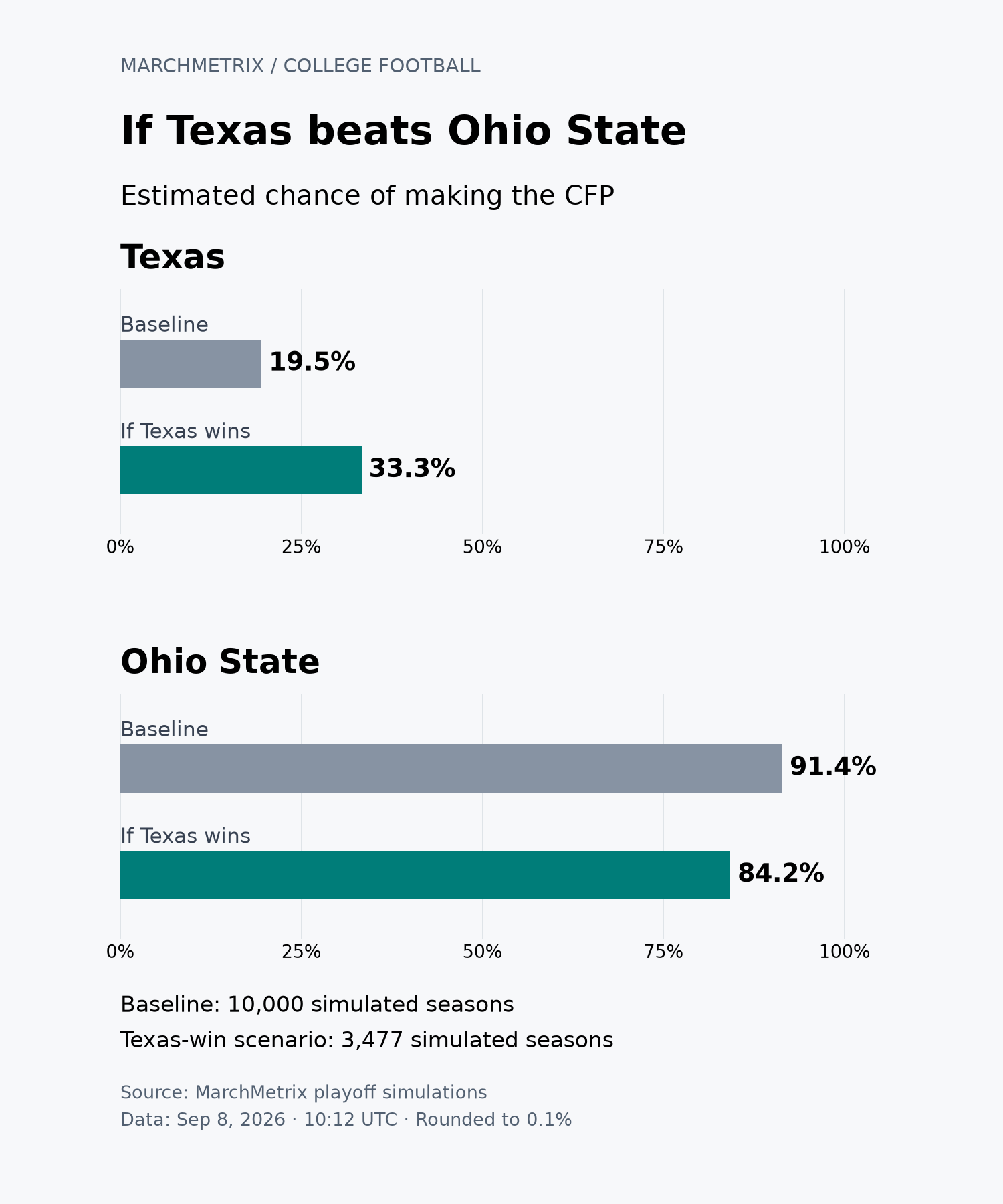
Playoff chances in the full simulation set versus the subset where Texas beats Ohio State. Baseline: 10,000 simulated seasons; Texas-win scenario: 3,477. Source: MarchMetrix playoff simulations, September 8, 2026, 10:12 UTC. Values rounded to one decimal place.
How much room does Ohio State have?
Ohio State starts from a much stronger projected position. The Buckeyes qualify in 9,139 of the full 10,000 simulated seasons. When the analysis is limited to Texas wins, Ohio State still qualifies in 2,927 of 3,477 seasons: 84.2%, a decline of 7.2 percentage points from baseline.
For a fan asking whether an Austin loss would end Ohio State’s playoff hopes, the model’s answer is clear: no. Most of the simulated seasons containing that loss still end with the Buckeyes in the field.
It would not make their remaining games inconsequential. The Ohio State schedule still includes trips to Iowa, Indiana and USC, a home game against Oregon, and the regular-season finale against Michigan. The 84.2% estimate includes a range of results across the rest of that schedule, including seasons in which Ohio State falls short.
What the scenario can tell us
These percentages describe the chance of making the playoff, not the chance of winning Saturday’s game. The baseline includes every simulated season, with either team winning in Austin. The Texas-win comparison keeps only seasons in which the Longhorns win and looks at how often each team ultimately qualifies.
That distinction matters when reading the changes. Texas’s 13.8-point gain is measured against its pregame baseline, not against its chances after a loss. Likewise, Ohio State’s 7.2-point decline is not the gap between winning and losing Saturday.
The figures are also a snapshot, not a promise about the next update. New results and refreshed ratings can change the outlook. For a broader explanation of the rating behind the projections, see how MMX-F rates college football.
For now, the strongest finding is the difference in the teams’ positions: a Texas win would meaningfully improve the Longhorns’ playoff chances while leaving Ohio State likely to qualify. Neither team’s season would be settled in Austin.
- MarchMetrix playoff simulationsas of Sep 8, 2026
Editorial version 1. The prose is pinned to the dates above. Spotted an error? How corrections work.